


Financial Outlook for 2011
Edward E. Edwards Professor of Finance, Kelley School of Business, Indiana University Bloomington
Associate Professor of Finance, Kelley School of Business, Indiana University Bloomington
Professor of Finance, Kelley School of Business, Indiana University Bloomington
The financial markets and the economy seem to be in parallel universes. The markets have rebounded strongly since the first quarter of 2009 while the economic recovery has been tepid. We expect that the financial markets and the economy will move closer together, with the markets increasing at a rate somewhat below average.
Despite the dramatic plunge during March 2009, the S&P 500 ended the year with an impressive 23 percent gain, as investors breathed a sigh of relief. The gains have continued in 2010, with the S&P 500 increasing an additional 10 percent from January to early November (see Figure 1). The Federal Reserve has maintained an aggressive position in monetary policy during this period. Short-term interest rates have remained close to zero through 2010 while long-term bond rates are very close to historical lows.
Figure 1: S&P 500, December 2007 to September 2010
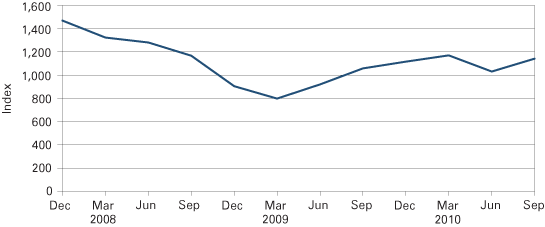
Note: Hash marks indicate the last day of each quarter.
Source: IBRC, using Standard & Poor’s data
On November 3, 2010, the Federal Reserve Board announced a new round of “quantitative easing.” This term describes the process where the Fed buys assets from banks and other financial institutions. The Federal Reserve has initiated two periods of quantitative easing, frequently called QE1 and QE2. QE1 involved the purchase of about $1.7 trillion of mostly mortgage-related assets from banks and ended in April 2010. The motivation was to reduce the risk exposure of banks by removing their distressed assets and simultaneously providing banks the liquidity to make new loans. QE1 has been successful in improving the financial condition of banks, although overall loan growth remains weak. QE2 has targeted the mid- to long-term portion of the Treasury yield curve. The idea is that when the Fed purchases these bonds, their price will rise and their yields will fall. If the yields fall enough, then banks will find it more attractive to make new loans rather than invest in Treasury bonds.
There is a general consensus that QE1 served its purpose, but there is considerable debate about QE2. The two concerns most frequently mentioned are the inflationary potential and the decline of the dollar. So far, the inflationary impact appears to be small. Both Treasury bond prices and TIPS (Treasury Inflation-Protected Securities) show little evidence of future inflation. The commodity and currency markets, however, offer a different perspective. The U.S. dollar has fallen sharply since the Fed indicated its intent to implement QE2. Since this favors U.S. exports over imports, many of our trading partners have been vocal in their opposition. In addition, many commodities (which are priced in dollars) have risen in price to apparently offset the devalued U.S. dollar. Both these trends are consistent with future inflationary pressures.
Economic Fundamentals
Stock prices are a leading economic indicator: investors buy stocks anticipating the real economy will pick up in the near future. There are many positive reasons to believe this story now:
- In October, the Conference Board reported that their index of leading economic indicators increased for the fourth straight month.
- Spending from the 2009 stimulus package will continue until 2011. Less than one-third of stimulus spending occurred in 2009. About one-half of the spending will be implemented in 2010 with the remainder scheduled for 2011 and beyond.
- Major banks, although still weak, have weathered the storm and are slowly rebuilding their balance sheets.
- The Federal Reserve is continuing to keep interest rates low to fuel the economy. The Fed Funds target rate of zero to 0.25 percent will be maintained for an extended period, probably well into 2011, and the 10-year bond rate will likely fall from its current rate of 2.6 percent.
- The decline in residential housing prices appears to be over in most parts of the country. The Case-Shiller Index has risen about 1.3 percent from September 2009 until August 2010. This is about 6 percent higher than its lowest value back in April 2009, but the change is not uniform around the country. For example, from September 2009 to August 2010, housing prices rose more than 6 percent in San Diego but declined 4 percent in Chicago.
- The weak dollar will help companies grow their exports.
- Corporate earnings have been remarkably resilient. Operating earnings for S&P 500 companies rose about 28 percent in 2010 and are expected to rise 15 percent in 2011.
However, there are negative issues that could make the market recovery short-lived:
- U.S. commercial real estate, valued at about $3.7 trillion, experienced a 5.1 percent increase in the four quarters from September 2009 to September 2010 according to the National Council of Real Estate Investment Fiduciaries (NCREIF). Commercial real estate is far below its peak in 2007 (about $5 trillion), but the relatively small increase over the last four quarters is broadly based with the East, South, Midwest and West participating roughly equally in the increase.
- While inflationary pressures have remained low (in the 1 to 2 percent range) commodity prices have been rising much faster—up 8 percent on average since the start of 2010. Eventually this will be reflected in higher production and transportation costs.
- In spite of the recent upturn, industrial output is still only at 74 percent of capacity, well below the long-run average (including previous recessions) of 81 percent.
- The massive government deficits may lead to fears of higher interest rates and accelerating inflation. The budget deficits for 2009, 2010 and 2011 will exceed 30 percent of U.S. gross domestic product (GDP). The federal government will need to borrow about $4.5 trillion to finance this spending. If this spending is financed by tax increases, the tax bill will average about $14,000 per person.
- As of August 2010, foreigners held $4.2 trillion of the $13.3 trillion of U.S. Treasury debt. This is a sharp increase from $3.5 trillion held a year earlier; however, we think the falling dollar and low interest rates may spark some resistance to keep funding our deficits.
- The United States still faces a huge funding deficit in Social Security and Medicare payments. The present value of these future payments has been estimated to be about $62 trillion. This is equivalent to $132,000 per person or $532,000 per U.S. household. These deficit problems are not insurmountable, but they do require common sense and bipartisan leadership.
Forecast
Looking forward to 2011, the positives outweigh the negatives for the economy. We expect the recovery to continue, albeit at a rate much slower than a typical recovery, with GDP growth in the 2 to 3 percent range and inflation in the 1 to 2 percent range. The pace of the recovery, however, will not improve until consumers have increased their savings and repaired their balance sheets. This process will extend beyond the end of 2011.
In this environment, we expect a positive return to equities but below the long-run average return of roughly 7 percent. With Treasury bonds already at extremely low yields, there is little potential for gains with these investments. It is possible that QE2 can make bonds attractive until at least mid-year 2011, but we think there are material long-term inflation risks that will soon make long-term bonds unattractive. In contrast, the low Treasury rates make mortgage rates extremely attractive, with 30-year fixed rates at 4.5 percent and 15-year fixed rates at 3.75 percent. Homeowners who are paying 6 percent or more on their mortgage and expect to stay in their home for several years would likely benefit from refinancing their mortgage.
Summary
The U.S. economy has survived the most brutal downturn since the Great Depression. The recession is over and the worst is behind us. The adjustment process to full recovery and full employment, however, will likely take at least two years. Until a complete recovery is in sight, we expect market returns to be positive but below average.
Also in this Issue…
- Outlook for 2011
- International Outlook for 2011
- U.S. Outlook for 2011
- Financial Outlook for 2011
- Housing Market Outlook for 2011
- Indiana's Outlook for 2011
- Indiana's Agricultural Outlook for 2011
- Anderson Forecast 2011
- Bloomington Forecast 2011
- Columbus Forecast 2011
- Evansville Forecast 2011
- Fort Wayne Forecast 2011
- Gary Forecast 2011
- Indianapolis-Carmel Forecast 2011
- Kokomo Forecast 2011
- Lafayette Forecast 2011
- Louisville Forecast 2011
- Muncie Forecast 2011
- Richmond Forecast 2011
- South Bend and Elkhart Area Forecast 2011
- Terre Haute Forecast 2011